Cedric John Hood — known to everyone simply as CJ — was raised Christian, with no early connection to India or to Hindu practice. That changed in 2010, when a conference took him to India for the first time. He arrived expecting a work trip and left with the sense that everything around him was, in his own words, spiritually charged. He felt called to return.
He went back determined to see the country differently — to try, as he puts it, to see India "through Indian eyes" rather than as a visitor passing through. That second journey took him to Gangotri, Yamnotri, Badrinath and Kedarnath, the great Himalayan pilgrimage sites, where he found himself quietly moved by the depth of devotion he saw in the people around him.
A third trip took him further still. Staying at an ashram in Hyderabad, a swami there gave him a book of quotations from her own guru, Swami Muktananda. Reading it, CJ describes something shifting in him — Shiva's energy, as he felt it, striking him in the heart. It was the beginning of a real change in direction. He bought a small Ganesh murti while still in India, and a Shiva murti once he was back home in South Africa. His understanding of Hindu practice grew slowly from there, alongside a new daily discipline of meditation and pranayama.
At the time, CJ was working in tourism. A doctor based in Johannesburg asked him to guide a group of visiting doctors from New Zealand and Australia. Afterwards, in conversation, the doctor mentioned he owned a property in the Drakensberg and asked whether CJ might be interested in running a business there. CJ visited, and loved what he found. Together with a friend who had a keen interest in reptiles, he started a small reptile centre on the land.
The business grew slowly, as new ventures do. Three years in, just as it began to turn a genuine profit, the doctor told CJ he was emigrating and offered him first right to buy the property outright — for R2.5 million, money CJ simply didn't have. Rather than panic, he did the only thing that felt available to him: he prayed to Ganesh, remover of obstacles, and surrendered the outcome to Shiva.
Three months later, an American group that regularly visited the property for spiritual training arrived with a first-time guest — a woman with no prior connection to the group. A day before she was due to leave, she told CJ that she believed he needed to buy the property, that he needed to be there, and she offered him a gift of R4.5 million, on the condition that she remain anonymous and that it came with no conditions attached. CJ was, understandably, sceptical. It was only a month later, when she called from the United States to confirm the offer still stood, that he began to believe it. The sale went through, and the property was formally transferred into his name roughly three months after that.
CJ has never described himself as the property's owner in any deeper sense. He calls himself its custodian — the caretaker of land he believes truly belongs to Shiva.
About a year after the transfer, during meditation, CJ received a clear sense that he should install a Shiva lingam of specific dimensions, oriented to face Mount Kailash. Word of this spread quietly, and before long a lingam matching those exact dimensions was donated to him. It stands on the site to this day.
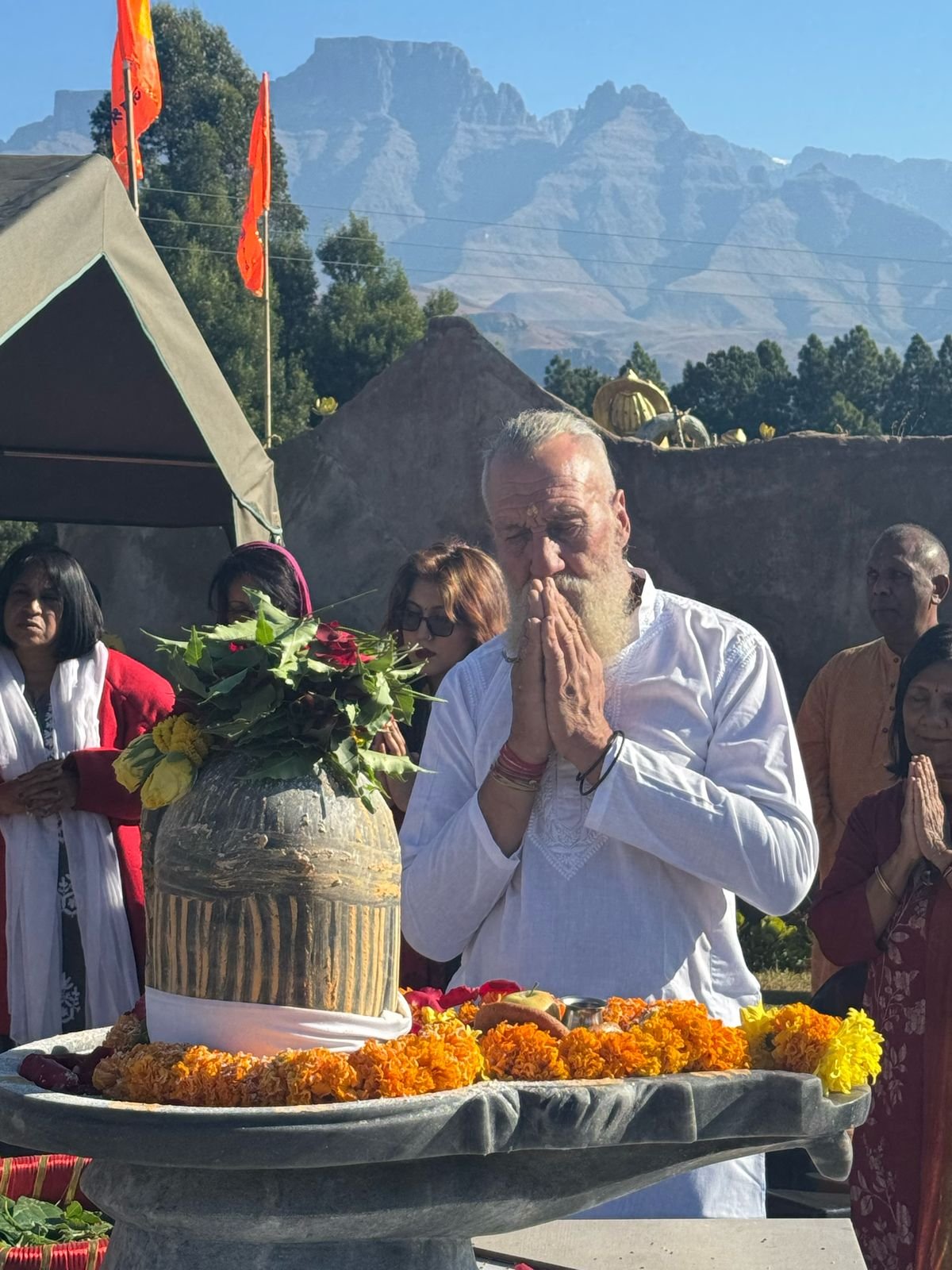
CJ tells the story of Shiva Kshetra in his own words.
A year after that, further guidance came, this time directing him to build a three-metre Shiva murti, aligned with the lingam and also facing Kailash. The framework and proportions were worked out by the father of CJ's business partner, a man with no formal training as a sculptor, starting from a small murti kept in CJ's own prayer room. The actual sculpting was done by the son, Corniel — a white Afrikaner artist from the Free State, with no background in Hindu iconography at all. The murti was completed in 2019.
Years later, a pundit who had trained for seven years in Varanasi visited the site and examined the murti closely. He told CJ the proportions were perfect — and was surprised to learn it had been made by someone with no background in the Hindu tradition or in sculpting murtis at all. CJ reflects on this simply: that Shiva placed exactly the people needed in position, regardless of their background or training.
When the murti was finished in 2019, CJ still saw the site as a personal, private practice — somewhere he prayed alone. That began to change after the COVID lockdowns eased and the reptile centre reopened. A Hindu woman from Escourt, visiting the centre, glimpsed the Shiva murti through the trees and mentioned it to her father, a pundit, shortly before Shivaratri.
He came out to the property with musicians and performed a bhajan for Shivaratri, filming the occasion and posting it on social media. The video spread quickly, and Shiva Kshetra began drawing pilgrims from far beyond the immediate area — becoming, gradually, the place it is today.
CJ still isn't entirely sure why this task fell to him — a man who wasn't born into the tradition, and who describes his own knowledge of Hindu philosophy as no more than "a grain of sand." But he has embraced the role fully, as a devotee of Shiva and as custodian of the ground he now cares for.